作品正文:
Theorem — Cauchy's Mean Value Theorem
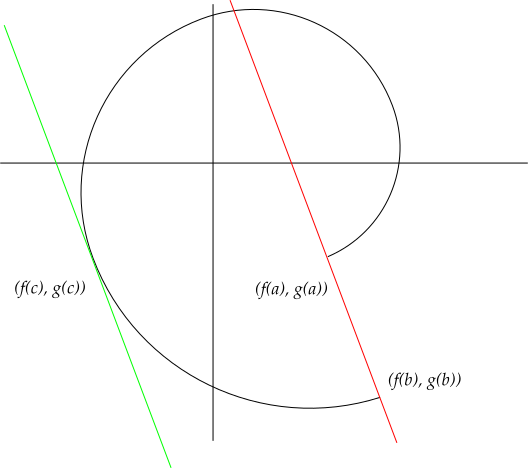
Let f and g be continuous on [a,b] and differentiable on (a,b). Suppose g′(x) ≠ 0 for every x ∈ (a,b). Then there exists ξ ∈ (a,b) such that


In calculus and real analysis, the mean value theorem (or Lagrange's mean value theorem) is a theorem about differentiable functions, roughly stating that the average rate of change of such a function over an interval is equal to the instantaneous rate of change at some point in the interval.
A special case of this theorem for inverse interpolation of the sine was first described by Parameshvara (1380–1460), from the Kerala School of Astronomy and Mathematics in India, in his commentaries on Govindasvāmi and Bhāskara II.[1] A restricted form of the theorem was proved by Michel Rolle in 1691; the result was what is now known as Rolle's theorem, and was proved only for polynomials, without the techniques of calculus. The mean value theorem in its modern form was stated and proved by Augustin Louis Cauchy in 1823.[2] Many variations of this theorem have been proved since then.[3][4]
Let f and g be continuous on [a,b] and differentiable on (a,b). Suppose g′(x) ≠ 0 for every x ∈ (a,b). Then there exists ξ ∈ (a,b) such that